Thursday, September 15, 2011

Comments Policy

I haven't had one of these officially in place, beyond the things I've mentioned in the About page.  Some unpleasantness in the 2011 applicants' comments, however, have prompted me to review my approach here, so let me just briefly outline what I believe and why, what you can expect of me as the host and moderator, and what I expect of you in return.

  1. First and foremost, this is my site.  Period.  I run it for your edification, information, and enjoyment.  I reserve the right to preserve those qualities aggressively by any means necessary.  That means deletion of comments and, if necessary, banning of users.
  2. I believe that your edification, information, and enjoyment are maximized by allowing open and frank discussions unencumbered by ties to your real identities.  (If you need evidence for this, check out the comparative level of engagement here with that on the various GovLoop PMF resources; nothing against GovLoop, of course, but adding someone's real identity tends to hamper some kinds of communication).
  3. To date, I have pursued this belief by maintaining a purely anonymous comments system.  I understand that there will always be trolls.  They are inevitable, even with more robust identity solutions.  The problems I encountered, however, were exacerbated by the inability to deal with each commenter as an individual.  
  4. I am changing my policy for this PMF season to be pseudonymous rather than purely anonymous.  That means you will have to register some account.  I don't care whether you want to use your real name or not.  That is your choice.  What I care about is my own ability to maintain the greatest level of edification, information, and enjoyment possible in this format.
  5. From you, I expect civility.  Joking, snark, sarcasm, criticism, complaints, bellyaching, and the like are all allowed.  But I expect that you do not harass one another or make abusive comments about individuals involved in this process. Racist and/or sexist remarks will likewise not be tolerated here, and I reserve the right to remove any comments that fail to meet the standards here. Or for any reason, really. Additionally, I will ban repeat offenders.  
So I think that sums up the what, how, and why of my approach to comments.  Feel free to express your opinions about this policy here, whether they are positive or negative.  
Finally, should you have any concerns about any of this and don't want to air them publicly, you may contact me at pmfellow@gmail.com. Yeah, that's me putting a real email address on a webpage.

PMF 2012: Application Begins Today

Yes, it's that time again. The Presidential Management Fellows application process is officially open for the 2012 application year. Here's a very quick rundown of how to determine if you are eligible and what to expect. At the end of this article are the other great resources available on the web. I will be happy to answer any questions you have about the application process, assuming I know the answers, but otherwise, just let us all know whether you are going to apply or not.

The application window for this year is today, September 15, 2011 to September 25, 2011. School nominations have to be in by September 30, 2011.

Eligibility

To be eligible, you MUST be enrolled in a graduate program of some sort and be scheduled to complete your degree requirements between September 1, 2011 and August 31, 2012. Seems easy enough, right?

The Process

First, and I can't stress this enough, you have to find out who at your school handles PMF nominations. It's usually the dean of your particular program. You don't get invited to take the test unless your school nominates you. Make sure your nominating official has all the information he/she needs to complete the nomination. All of the materials you need can be found on the PMF website.

Second, go over to the job listing on USAJOBS and apply for the program. You can find it here: http://jobview.usajobs.gov/GetJob.aspx?JobID=102311164

Third, make sure all of your documents are saved all the way through on Application Manager. You can provide corrected documents if you need to, but sometimes they require processing time. In that case, it's better to get your application in early.

And fourth, let us know here or on GovLoop that you've applied. We like to have conversations here about the experience and what everyone else is going through. And since I have been through the process myself, there are things I can probably help you with. Good luck, everyone!

Resources

Thursday, August 25, 2011

PMF 2012: Tentative Calendar

It's almost that time of year again, folks. A couple of days ago, the PMF Program Office announced its anticipated application schedule for the 2012 cycle. Under current regulation, students must be completing a graduate degree between September 1, 2011, and August 31, 2012, to be eligible to apply. (This means, of course, that we won't see the effects of the recent changes they've proposed until at least the 2013 application cycle). Anyway, the application period should open on September 15, 2011, and close on September 25, 2011, with all nominations completed by the schools by September 30, 2011.

Additionally, there is a new tentative calendar available outlining the 2012 process. It is much more compressed than in years passed, as you'll notice.

DateDescription
Thursday, September 15, 2011Application for the PMF Class of 2012 opens via a job opportunity announcement on USAJOBS; search for "Presidential Management Fellows"
Sunday, September 25, 2011Application for the PMF Class of 2012 closes
Friday, September 30, 2011
  • Deadline for Nomination Officials to fax nominations
  • Deadline for applicants to submit supporting documentation for any claims for Veterans' Preference.
October 1-10, 2011Invited applicants participate in on-line assessment process
By November 1, 2011
  • Applicants notified on eligibility and nomination status
  • Semi-finalists selected and notified
  • Semi-finalists scheduled and notified for in-person assessments
November 14 - December 16, 2011In-person assessments conducted for semi-finalists
January 24, 2012On or around this date, semi-finalists notified of Finalist status via email
Late-February/Early- March 2012PMF Class of 2012 Finalists Job Fair (Washington, DC, metro area)


This time around, finalist notifications are expected to go out in late January!

I'd be interested to see what you all think of this aggressive schedule. Also, it's worth pointing out that, given the possible new rules that could affect next year's application cycle, you may benefit from the ability to apply more than once. In fact, I can foresee a possibility that you could apply up to three times, given that the new rules would allow eligibility to be extended back two years for degree completion. So what I am saying is go for it this time, and if you don't make it through, try it again next year if you're still inclined.

Friday, August 5, 2011

Summer Update: PMF Program Changes Afoot

This is the slow season in the life of a blog like this, but occasionally things do happen that are worth noting. Before getting to the big stuff, though, I figure it's worth providing a quick update.

First, I should point out that there are 327 listed PMF hires to date. I have no idea how that compares to previous years, unfortunately, but considering the historical placement rates have fallen between 40 and 60 percent of finalists, we can expect something like 340 to 510 to be placed out of this class. Anecdotes from people who can't find a placement aside, 327 seems to be a good number at a point approximately 1/3 of the way through the placement cycle. More positions will undoubtedly appear, so if you haven't secured anything yet, just give it some time.

Second, it's almost time for the next class to apply. OPM plans to open up the 2012 program sometime in September. As I did last year, I will write a post about the program with updated statistics and description. It would be helpful if any of you who have already been placed would submit your experiences with the program so far, especially where the initial application is concerned.

And finally, OPM has submitted its proposed rule changes to the Federal Register to amend its Pathways Program, which includes the PMF program. The biggest change I see so far in my reading of the proposed regulation is the widening of the application window to two years. That is, anyone who completed a graduate degree within the last two years would be eligible to apply. There are other important changes, though, so for a more thorough highlighting, read below.


PMF Program Revisions Highlighted
  1. No More Nominations - The proposed regulation removes the requirement for college or university staff to perform the nomination action. This step of course removes the burden from nominating officials who may be less connected to PMF aspirants in future classes, because up to two years may have passed since the last interaction between the PMF hopeful and the nominating official.

  2. Apply Again - As long as someone falls within the two year window outlined by the regulation, there is nothing prohibiting people from applying again if they were unsuccessful the first time around. So those of you on the finalist list right now who haven't been placed yet might get another chance or two to apply. This is a pretty significant structural change, but I suspect most programs have to deal with repeat applicants. And who knows? Perhaps an extra year working will be the thing that gives you an edge over other finalists.

  3. "Interactive" instead of Classroom Training - OPM is clarifying the language surrounding the training to emphasize that delivery methods other than instructor-led classroom training can fulfill the annual training requirements. Frankly, this is long overdue. We're in an age where the most efficient delivery methods for focused training are internet-based, and while there is definitely value to be found in classroom training, it should be limited to situations that warrant it. This will probably go a long way toward making the program more palatable to agencies, since there is a great deal of decent-quality online training that was of dubious value to PMFs given the earlier requirement that they can now use.

  4. SES Mentors - The new rules would require agencies that hire PMFs to match them up with a mentor at the Senior Executive Service level. Overall, this is probably a good thing. I learned a great deal from those SES with whom I have served.

  5. Rotation Adjustments - The program still includes provisions for a 4-6 month developmental assignment, but OPM has included some intriguing language about the viability of agency-wide, Presidential or Administration initiatives for use as developmental activities. I can imagine some potential applications of this, but would be interested in what any of you think about it.


Those were the major points I found in the document after scanning through it. Give it a read and let us all know what else you find in it.

Friday, May 20, 2011

Question: Where Should the In-Person Assessments Have Occurred?

This is definitely something exploratory, and it's certainly not intended to be predictive. I am just musing here, partially to determine whether the in-person assessment locations were sound or not.

So the question is this: Based on what we know of the 2011 semifinalist pool, where would the most effective in-person assessment locations have been? Let's broaden that a bit to get at what we really might want to know. Which cities with a Federal presence would have made good cities in which to conduct PMF in-person assessments, based on what we know about where the semifinalists (those invited to the in-person assessments) presumably originated? I hope that's a clear question, but we can break this down into components so the criteria are better defined, and the follow-up questions are enumerated.

  • Federal presence: This can mean one of a few things. First, and fundamentally, is there any Federal agency with an office in the city? For many cities, the answer is a qualified yes. Qualified, because even if a city has some Federal presence, this does not mean that the city is at all suited to hosting in-person assessments, either because it is located too far away from the bulk of semifinalists, or because it is simply too small to provide convenient transportation options. It turns out there is another way we can measure Federal presence in a city: The Federal Executive Boards (FEB). FEBs form a nationwide network of Federal branches providing communication and collaboration solutions to agencies outside the DC area. Given their wide geographic distribution, it seems clear that FEB cities might serve as a good starting point to analyze future in-person assessments. In the graphics below, I show a summary view of how many semifinalists were listed as closest to each of these cities.
  • Semifinalists: I chose semifinalists from this year 1) because there were semifinalists for 2011, and 2) because semifinalists were the ones invited to take in-person assessments. It doesn't make much sense to me to choose nominees or finalists for this particular comparison, although choosing nominees would at least provide some information for future planning. What we know about semifinalists is the school they listed in their materials, and not much more. This is a limitation of the data set, of course, but it's all we have to work with. What we have to assume from it is that the schools in question were correctly identified for purposes of geolocation; that every semifinalists were correctly listed with their schools; and that the locations of the schools reflect the geographic origins of the semifinalists. That's a tall order, but again, what choice do we have? Some of these schools conduct extensive online programs that mean students could be widely dispersed beyond the brick-and-mortar campus. What we have, then, is close enough approximation of the truth for this analysis.
Now our question becomes this: Of the FEB cities, which are closely located around the most 2011 semifinalists? That is a question we can answer. I took the cities in which there are FEB offices and calculated the distance from that city to each of the 278 schools represented in the semifinalist data. Then I figured out, for each school, which was the closest FEB city. And finally, I aggregated the FEBs and summed up the semifinalists that were listed as closest to each FEB. That data is shown below:


One thing you'll notice, of course, is that Washington, DC, is listed here, even though it's not an FEB location. I trust you'll understand why this is the case. Regardless, what we see is that, outside Washington, DC, the top 5 FEB locations are Boston (161), Atlanta (118), New York City (110), Chicago (92), and San Francisco (76). If we were looking for validation of the 2011 in-person assessment location choices, this might suffice. What the top 5 FEB list doesn't really account for, though, is that there are significant numbers in other locations. The trick here would be to determine locations that are central to a region in some way. DC makes sense for most of the East Coast, especially given the ease of transportation between, for instance, Boston and DC. It is entirely fitting, then, to keep DC as an assessment location. Atlanta also makes sense for large portions of the South. The Midwest is well served by Chicago, and the West Coast is well served by San Francisco (although Los Angeles looks to be a good second choice). That just leaves areas like the North Plains and the Southwest less well served. But we can frame a different question that might help here. Let's eliminate all but one NE city (DC), one Southern city (Atlanta), one Midwest city (Chicago) and one Western city (San Francisco), leaving the others on the list to see what we can come up with. That leaves us with the following:


Based on this, I think we can recommend that either a city in Texas or Oklahoma City could serve as the only other location needed. I am choosing OKC because of its fairly central location compared to Denver and Albuquerque. If we do that, then the numbers look like this:


Even so, the payoff for adding OKC is much lower than other locations, and it may not ultimately be worth the effort to add the assessment location.

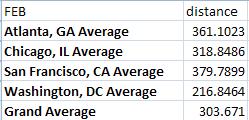
Next, let's see if we can determine whether there's a distance factor involved here. That is, if we take these five locations, is there an average distance we're looking for that might be ideal? The first table shows us a widely variable average distance between the school and the assessment center.


The largest average is for DC, but this can be partially explained by the large distribution of semifinalists (Boston to a point about halfway between Atlanta and DC) and the inclusion of overseas schools in this list, all of which are in excess of 2000 miles away. There aren't many, but they are enough to affect the result. Filtering those out will give us perhaps something more meaningful.


So there you have it. These are pretty good distances from what I can tell, but I am interested to know what you all think. As one final point of comparison, here are the average distances to the original in-person assessment locations. By omitting OKC, we raise the averages for Chicago, San Francisco, and Atlanta, but DC is unaffected.


Conclusion
So after examining the locations that might have made sense for the in-person assessment, what we found is that the original locations seemed to be about right. We could fragment the assessment centers a bit more by adding one in OKC, but doing much more than that seems to have a lower benefit. What do you all think? Were these distances doable for you? I know many of you would have preferred not to travel as far as you did, but consider the alternatives (such as all in-person assessments being held in DC). What locations do you think should be considered?

2011 PMF Appointments: Another Open Thread

The reason for this post is simple: I have Google set to turn on comment moderation on posts older than 30 days. If I don't post something today or tomorrow, those of you still conversing will have to wait for your comments to be published by me. Not only does this hamper your conversations, it is a bit burdensome to me as well, which is why I changed the site from moderating everything to what it is now (that was a while ago). Had I not done that, I would have had to approve all of the 2000+ comments you all have written over the past 3 months. As it is, I READ every comment, but I don't feel the need to moderate them all.

Anyway, please continue sharing your experiences as you go. I am planning some other exploratory and data analysis posts, but that process has gone a bit slower than I had desired. (This is *totally* not a call for some part-time help, no way, no how...OK, it is, if anyone wants to)

I'm not posting this one on GovLoop, because the threads over there are far from full. Ghost town is more like it.

Oh, and if there is a specific kind of post you would like me to write, let me know. I do take requests.

Thursday, April 21, 2011

2011 PMF Survey: How did you do?

If you are a 2011 PMF finalist, please take the time to fill out this survey. I am collecting this information to get an idea of how effective the job fair was, and some information about the placement rates and geographic distribution of finalist appointments. If your information changes, go ahead and submit a new form. I will perform all the data cleanup this time next year or thereabout, once you all have had a chance to secure an appointment. Pass this link around to all of the 2011 PMFs you know or meet over the next year. If you want access to the information, email me at pmfellow@gmail.com and tell me your name, your school, and your degree so I can make sure you are who you say you are.